

Document Type
Poster
Files
Download Full Text (1.6 MB)
Description
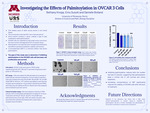
Ovarian cancer is a disease characterized by the abnormal growth of cells in the ovaries often due to mutations in our DNA. Because ovarian cancer is typically diagnosed at advanced stages, the survival rate is less than 40% over a five-year period. One significant influence of this cancer is palmitoylation - a post- translational modification in which fatty acid chains are added to specific cysteine residues in proteins. This modification alters protein localization, stability, and function. When dysregulated, as seen in ovarian cancer, palmitoylation can promote irregular cell growth, mutations, and ultimately cancer. However, the role of palmitoylation in cancer remains poorly characterized. To better understand this mechanism and its effect on ovarian cancer cells (OVCAR-3), colony formation, and MTT assays (cell
viability assays) were used to study how cancer cells survive and grow after treatment with 2-bromo- palmitic acid (2BP), a drug that inhibits palmitoylation. For the MTT assay, OVCAR-3 cells were plated
and treated with increasing concentrations of 2BP for 48 hours. We found that treatment with 2BP decreased cell viability in a dose-dependent manner. Similarly, for the colony formation assay, cells were plated and treated every three days for two weeks, followed by staining the colonies for visualization. We found that the number of colonies decreased as the drug concentration increased. Together, these results suggest that inhibiting palmitoylation leads to an increased rate of cancer cell death, indicating that palmitoylation may promote cancer cell proliferation and metastasis. This research may be useful as a possible therapeutic course of action for cancer patients.
Publication Date
4-16-2025
Keywords
Ovaries--Cancer; Palmitoylation
Disciplines
Chemical and Pharmacologic Phenomena | Neoplasms
Recommended Citation
Knopp, Bethany and Suzuki, Emu, "Investigating the Effects of Palmitoylation in OVCAR3 Cells" (2025). Undergraduate Research Symposium 2025. 8.
https://digitalcommons.morris.umn.edu/urs_2025/8
Primo Type
Conference Proceeding